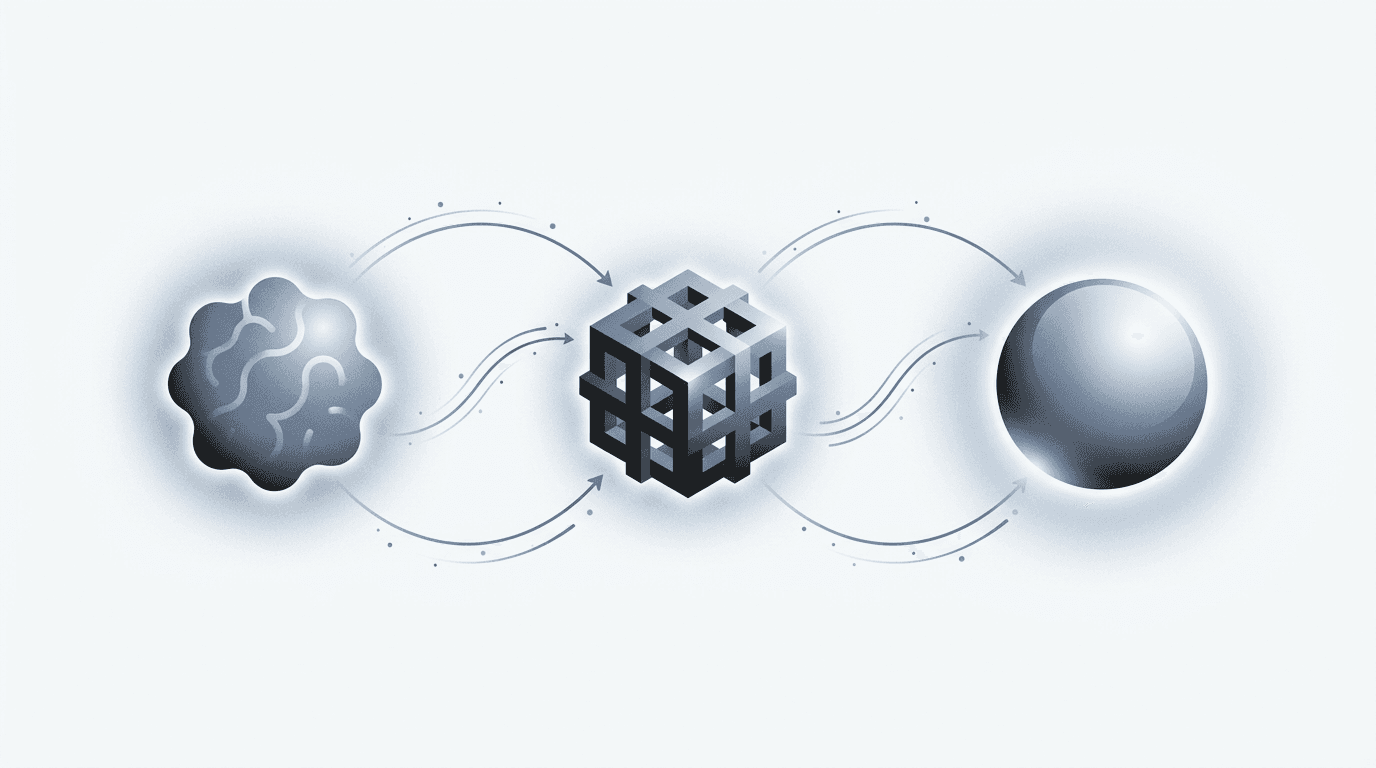
How It Works
Three steps to
compounding intelligence
From disconnected data to an intelligence layer that understands your business, detects what's wrong, and tells you what to do.
Step 1
Connect everything
Every document, every system, every data source your business runs on. Ontos ingests it all and immediately begins extracting entities against your domain's .onto schema — with provenance tracking from day one.
PDF documents
DOCX / Word
XLSX / Excel
CSV / TSV
CRM systems
ERP platforms
SQL databases
REST APIs
Email archives
SharePoint
Google Drive
Slack / Teams
// Entity extraction against .onto schema
source VendorContracts {
type: "document_store"
path: "/contracts/vendors/**/*.pdf"
extract: [Company, Person, Obligation, PaymentTerm, Date]
provenance: tracked // every fact traces back to source
refresh: on_change // re-extract when documents update
}
// Result: 847 entities extracted from 142 documents
// 23 companies, 89 people, 312 obligations, 423 terms
// All typed. All sourced. All connected.Step 2
Understand the relationships
This is where Ontos diverges from every other platform. We don't just store entities — we resolve them across systems, map their relationships, detect contradictions, and build a living knowledge graph that enforces business logic.
Entity resolution
"John Smith" in your CRM, "J. Smith" in the contract, and "jsmith@company.com" in email — resolved to a single entity with merged attributes and confidence scores.
Relationship mapping
People → Companies → Contracts → Obligations → Deadlines. Every connection typed, directional, and traversable. Not a flat index — a graph.
Contradiction detection
Contract A says net-30 payment terms. Contract B with the same vendor says net-60. The system flags this automatically — before it becomes a dispute.
Cross-document intelligence
An insight in one document becomes context for every other. A risk flagged in a board minute connects to the contract that created it and the person responsible for it.
This is where the .onto model comes alive. Not a static schema — a reasoning engine that understands the structure of your business.
Step 3
Deploy AI that acts
AI agents deployed on top of the unified context. They don't just answer questions — they reason over your entire business graph, take action, and surface intelligence you didn't know to ask for.
Natural language queries
Ask anything in plain English. Get answers with citations, confidence scores, and source provenance. Not a chatbot — a reasoning engine.
Proactive alerts
When new data triggers an inference rule — a contract contradiction, a risk threshold breach, a compliance gap — the system tells you before you ask.
Report generation
IC memos, due diligence summaries, compliance reports, risk assessments. Generated from structured intelligence, not hallucinated from text chunks.
Workflow automation
Flag risks for review. Route documents to the right team. Trigger approval workflows. Create tasks from intelligence — not just insights.
The Difference
Most platforms stop at step 1.
They ingest documents and let you search. Maybe they chunk text and call it RAG. Ontos goes to step 3 — a reasoning engine that understands your business structure, detects what's wrong, and tells you what to do.
Other platforms
Ingest → Search
RAG tools
Ingest → Chunk → Chat
Ontos
Ingest → Reason → Act
Timeline
Three weeks. Not six months.
No 6-month implementation. No consulting theater. No “phase 1 discovery workshops.”
Week 1
Connect your data
We integrate your document repositories, databases, and systems. Entity extraction begins immediately against your domain ontology.
Week 2
The model maps your business
The ontology runtime resolves entities across sources, maps relationships, detects contradictions, and builds your unified knowledge graph.
Week 3
Working intelligence layer
AI agents are deployed on top of the unified model. Natural language queries, proactive alerts, and automated workflows — all live.
Start your
free pilot.
Send us 5 documents. We'll show you what your AI has been missing.